Digital Cable TV Transform Your Vision into Creative Results

Wold is moving towards Digitization and Digital Cable TV is one its part. Digital Headend is the heart of the Digital Cable TV. A cable head-end (or headend) is the facility at a local cable TV office that originates and communicates cable TV services to subscribers. In distributing cable television services, the head-end includes a satellite dish antenna for receiving incoming programming.

Cable television is a system of delivering television programming to consumers via radio frequency (RF) signals transmitted through coaxial cables, or in more recent systems, light pulses through fiber-optic cables. The abbreviation CATV is often used for cable television. It originally stood for Community Access Television or Community Antenna Television, from cable television’s origins in 1948. In areas where over-the-air TV reception was limited by distance from transmitters or mountainous terrain, large “community antennas” were constructed, and cable was run from them to individual homes.

Cable television transmits signals via a coaxial cable that plugs in directly to the television set or the nearest cable box while using either analog or digital signals. Digital TV, on the other hand, transmits high-quality digitally encoded signals rather than unconventional analog methods. A Digital TV signal, on the other hand, transmits in “packets” of compressed data. The data uses a combination of 1’s and 0’s, similar to your computer, DVD player, and the Internet. Because it uses this code, digital signals do not experience the same interference or signal loss, that analog TV signals do. Digital cable is the distribution of cable television using digital video compression for distribution. The technology was developed by General Instrument, which was succeeded by Motorola[1] and subsequently by ARRIS Group. Cable companies converted to the digital cable during the 2000s, during the period that broadcast television converted to the digital HDTV standard, which was incompatible with existing analog cable systems. In addition to providing higher resolution HD video, digital cable systems provide more services such as pay-per-view programming, cable internet access, and cable telephone services. Most digital cable signals are encrypted, which reduced the incidence of cable theft which occurred in analog systems.

Digital Headend
Boost your Success

Digital cable technology has allowed cable providers to compress video channels so that they take up less bandwidth and offer two-way communication capabilities. This has enabled providers to offer more channels, video-on-demand services that don’t require a separate telephone line, telephone services, high-speed internet services, and interactive television services. Digital cable implements error correction to ensure the integrity of the received signal and uses a secure digital distribution system (i.e. a secure encrypted signal to prevent eavesdropping and theft of service.)

Most digital cable providers use QAM for video services and DOCSIS standards for data services. Some providers have also begun to roll out video services using IPTV or Switched video.

quality network solution

whats new in Digital Cable TV solution?

Depending on your requirements and ability, you may purchase Solution and product
(Economic, standard high end Solution) - remember Quality and durability cost

Safeviewfinal_edited_edited

IRD, ENCODER, QAM

Click below to know more feature of Integrated Receiver Decoder (IRD), Encoder and QAM
Click Here
Safeviewfinal_edited_edited

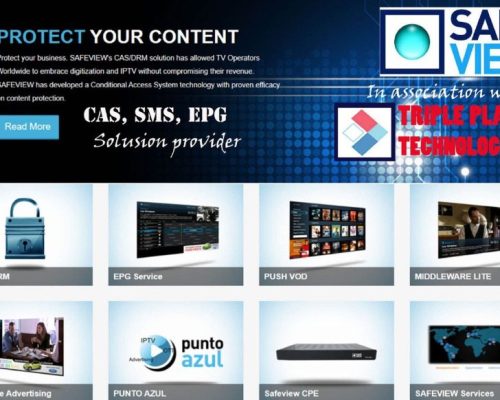
CAS, SMS & EPG

Please click below to know more about Conditional Access System (CAS), Subscriber Management System (SMS), Electronic Program Guide (EPG)
Click Here

SET TOP BOX

Please click below to knoe feature of diffrent brand and type (SD & HD)
Click Here

@ Tripleplay Technology BD

Main Menu